

May 20, 2026
When Faster Solar Inspections Drive Faster Decisions: Why Turnaround Time Is Becoming a Competitive Advantage
Everyone in solar O&M already knows that drones are faster than manual inspections. That's table stakes. The more consequential question, the one that determines asset revenue, maintenance ROI, and claim outcomes is this: what does faster inspection actually unlock, and what does slow inspection quietly cost?
In utility-scale solar operations, inspection turnaround is no longer just an operational metric. It shapes how quickly faults are resolved, how much generation revenue is protected, and how fast a site recovers after a weather event determining whether your asset performs to its financial model or quietly bleeds yield against it.
The value of modern drone solar panel inspection workflows is no longer visibility. It is decision velocity. At scale, faster decisions translate directly into measurable financial outcomes.
From Inspection Speed to Decision Velocity
Most solar inspection discussions focus on how quickly drones scan a site compared to manual thermography teams. But scan speed alone means very little operationally.What matters is the total time between: Fault occurrence → detection → diagnosis → maintenance action. Each stage adds lag. In a utility-scale plant generating at ₹4-6 per kWh, that lag has a direct price tag.
Turnaround time is no longer simply "time to report." It is time to actionable insight, the point at which a geo-referenced, defect-categorized report reaches the hands of someone who can act on it.
Modern AI-assisted inspection workflows compress the entire operational loop:
- Site-wide visibility
- Defect categorization
- Exact table-level identification
- Maintenance prioritization
- Ground team deployment
The contrast with conventional workflows is operational, not marginal:
How Faster Solar Inspection Turnaround Improves O&M Performance
Faster Fault Detection and Resolution
One commissioned solar site faced severe underperformance immediately after deployment, generating lower output than expected. The challenge was not identifying whether a problem existed. The challenge was identifying exactly where the faults were across thousands of panels.
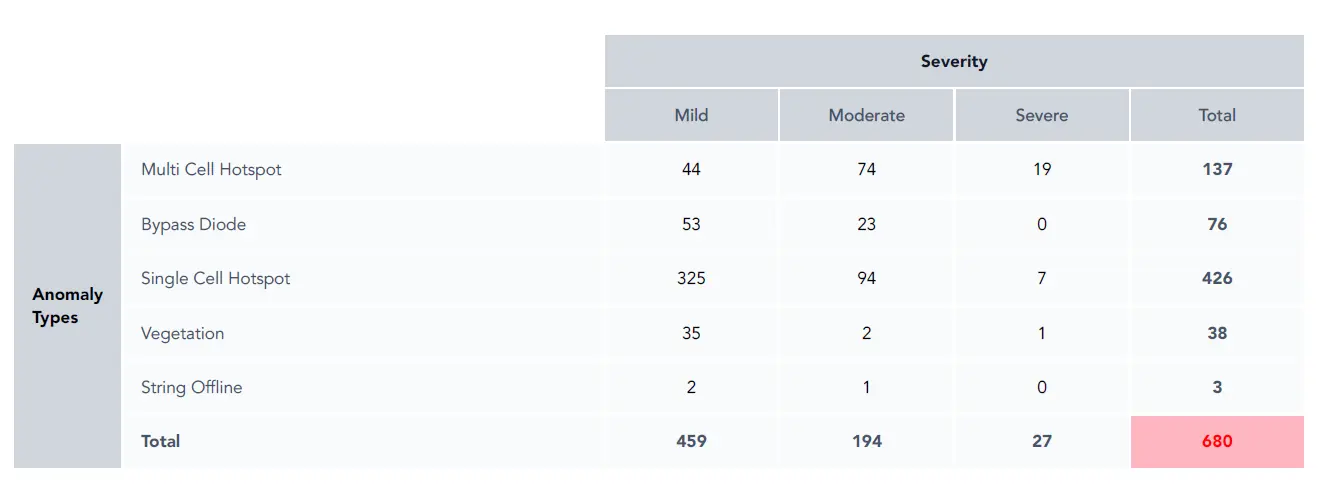
Skylark Drones’ rapid inspection workflow divided the plant into multiple inspection blocks, with autonomous missions completing in approximately 20-25 minutes each. Total of 17,263 anomalies across 41 blocks, affecting 18,476 modules, with an estimated DC power loss of 1.77 MW were identified in this single deployment. Thermal and RGB videography inspections enabled panel-level analysis across the site.
Within the workflow:
- Inspection data synced automatically from Drone Mission Ops to Spectra
- Faults were categorized into 6-7 defect types
- Defects were geo-referenced using polygon-based mapping
- Exact table-level fault identification was provided


Most importantly, the final actionable solar inspection report was delivered within 2 days. Conventional inspection timelines for comparable sites can often extend to nearly 2 weeks. That difference fundamentally changes how quickly ground teams can intervene.
Maintenance Prioritization
In large utility-scale assets, not every anomaly requires immediate action. Some defects create critical generation loss. Others can be grouped into planned maintenance cycles.
Rapid inspection from drone thermography turnaround allows O&M teams to prioritize based on severity of thermal anomalies, generation impact, fault clustering patterns, safety implications, accessibility of affected sections.Instead of dispatching teams broadly across the site, operators can direct maintenance resources precisely where operational impact is highest. Maintenance becomes a prioritized queue, not a reactive scramble.
Post-Incident Assessment: How Drone Thermal Imaging Cuts Downtime at the Source
After a weather event, hail, high winds, or dust storms common to Rajasthan and Gujarat solar corridors, the asset owner's primary variable is time to damage quantification. Without it, restoration planning cannot begin, insurance documentation cannot be assembled, and generation loss compounds.
Across Skylark’s operational solar thermography inspection deployments:
- 240+ instances of string failure were detected and geo-located during post-event thermal inspections
- Full thermal scans completed within approximately 1 hour post-event
This preserved nearly 3.6 MW of idle generation capacity, translating to ~₹35 lakhs in generation losses avoided. That is the real business impact of faster solar inspection turnaround. Not simply faster inspection. But faster recovery of revenue-generating performance.
Insurance Claims: Speed of Evidence Is Speed of Settlement
For solar insurance claims in India, the documentation bottleneck is the primary driver of delayed settlements. Insurers increasingly require module-level damage evidence, geo-referenced inspection records, thermal anomaly classification and quantified generation impact analysis. Manually assembling that evidence package can take weeks.
Skylark's post-incident inspection report, IEC 62446-3:2017 compliant, DGCA-certified, thermally calibrated, and georeferenced at the table level is that evidence package.


Research published by PV Magazine USA highlights how AI inspection data is increasingly being adopted within solar risk assessment and insurance workflows. Similarly, insurance-focused drone inspection analysis from Clyde & Co. notes that drone-documented claims can significantly accelerate evidence collection and adjudication timelines.
Why This Is Especially Consequential in India
India added approximately 44.61 GW of solar capacity in FY 2025-26, the highest annual addition in the country's history. The installed base is expanding faster than inspection infrastructure in most portfolios.
India's solar geography compounds the challenge. Sites in Rajasthan, Gujarat, and Andhra Pradesh face high dust accumulation rates, seasonal temperature extremes, and weather events that create both routine degradation and acute damage scenarios. Remote location, limited ground crew availability, and sparse local expertise make rapid autonomous inspection especially valuable human mobilization timelines in these geographies routinely add days to conventional solar O&M workflows.
Additionally, as institutional investors, infrastructure funds, and international IPPs increase their exposure to Indian solar assets, documentation standards are rising. Investors and insurers increasingly require structured,compliant solar plant performance audit data, not field photographs and handwritten logs. Inspection velocity, in this context, is also a credibility signal.
Turnaround Time Is a Competitive Advantage in Solar O&M
As utility-scale solar operations continue expanding across India, the competitive advantage will increasingly belong to organizations that can identify, validate, and act on operational issues fastest.
For operators evaluating scalable monitoring approaches, autonomous workflows such as drone dock-enabled solar infrastructure inspections are also beginning to reduce the operational friction of repeat inspections across distributed solar assets.
If your current O&M or post-incident inspection workflow is measured in weeks, there's a revenue gap hiding in that timeline.
→ Talk to Skylark's team about autonomous inspection programs for your solar portfolio.


