

The Solar Site That Monitors Itself: Why Autonomous Drone Docks Are Becoming Core EPC Infrastructure
It's 6 PM. The Site Has Already Filed Its First Report.
The project manager opens his laptop before wrapping up for the day. On his dashboard: a completed perimeter sweep from 6 PM, a time-stamped orthomosaic comparison showing same-day progress across the south construction zone.
No pilot was dispatched. No mission was manually triggered. No one pressed a button.
The drone dock ran its scheduled route, returned, charged, and queued the next mission on its own.
This isn't a future scenario. It's the operating reality on India's most advanced utility-scale solar construction sites right now. And it's reshaping how EPC contractors think about project governance at scale, with solutions from companies like Skylark Drones quietly enabling this shift in how monitoring is executed and consumed.
The Monitoring Problem That Scaled Faster Than the Solutions
A 500 MW solar EPC project today involves millions of modules, hundreds of mounting structures, and construction crews working across multiple blocks simultaneously all under a commissioning deadline tied to a power purchase agreement. Miss that deadline, and liquidated damages kick in.
Yet the monitoring infrastructure on most sites hasn't kept pace.
Progress reports come from contractors. Safety audits happen periodically. Head office receives a summary every few days. On a 150 MW-plus site, that rhythm creates systemic blind spots. A structural defect in Block 7 doesn't appear in the subcontractor's next report. By the time a manual inspection reaches that block, the module rows above it are already installed. A one-day remediation becomes a five-day schedule slip that ripples into commissioning.
The defect wasn't hidden. It simply wasn't seen in time.
Solar got bigger. Solar EPC construction monitoring didn't keep up.
Why Manual Drones Solved Half the Problem
Operator-deployed drones were a genuine step forward. Aerial thermal imaging caught anomalies that ground-level walkthroughs missed. RGB capture enabled faster, more accurate progress mapping. The quality of inspection data improved considerably.
But operator-dependent deployment has a structural ceiling:
- Scheduling flights across multiple concurrent sites is a coordination challenge
- Weather delays, travel logistics, and equipment issues create gaps in what needs to be continuous monitoring
- Even with an experienced pilot on site, a 200 MW project cannot be fully covered in a single session so teams prioritize, which means areas go unchecked
The hidden costs compound quickly: mobilization time, rescheduling friction, inconsistent flight paths that make time-series comparisons unreliable, data sitting unprocessed because there's no standardized pipeline on the other end. Across a 12-month EPC project, those friction points accumulate into a substantial cost in both money and decision quality.
The solar farm drone inspection cost on a budget is the visible number. The cost of delayed detection, inconsistent coverage, and fragmented data is what drives actual project overruns.
Drone Docks: From Inspection Tool to Monitoring Infrastructure
An autonomous drone dock is not a smarter version of manual deployment. It's a different category of infrastructure entirely.
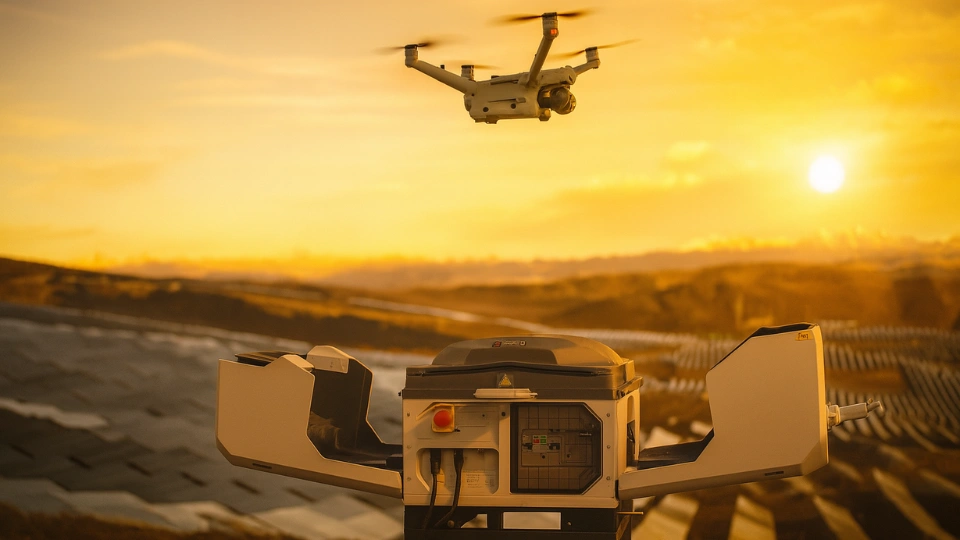
The dock is a permanently installed, weather-sealed unit mounted at a fixed point on the site. Missions launch on pre-configured schedules or on remote command when a project manager needs a real-time look at a specific zone. The drone takes off, executes its flight path, captures data, returns, and charges, with minimal human involvement in routine operations. Pilots remain available for on-demand missions, special scenarios, or whenever the situation calls for direct intervention.
This distinction matters. The value of autonomous UAV solar farm monitoring isn't just speed or coverage it's the dramatic reduction of human dependency from the inspection cycle. Continuous, schedule-driven monitoring becomes structurally viable for the first time.
A drone dock deployed at construction start builds a time-series record of the entire project lifecycle. By the time the asset transitions to an O&M owner, a complete monitoring baseline installation imagery, commissioning records, thermal datasets is already in place.
Deployed this way, a drone dock isn't an inspection asset. It's remote governance infrastructure.
How the System Works: A Day on a Monitored EPC Site
A typical autonomous deployment runs multiple mission types on staggered schedules across a single day:
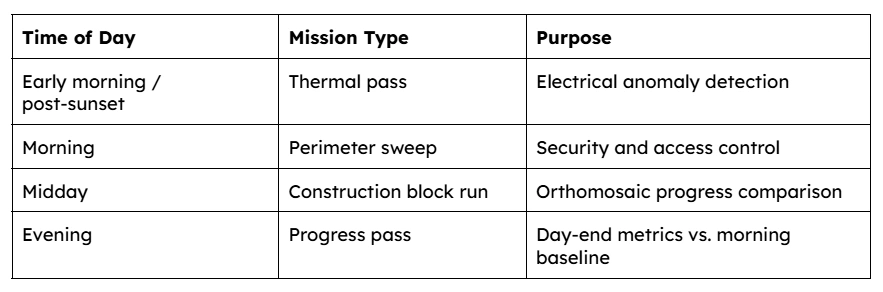
Mission planning and scheduling at this level of precision requires a dedicated flight management layer. Drone mission planning platform (DMO) handle the operational side of autonomous monitoring configuring flight paths, managing mission queues, coordinating coverage across multiple zones, and enabling remote triggering when project managers need a real-time look at a specific block.
After each flight, the data pipeline runs automatically. This is where intelligent analysis becomes the differentiator. Solar construction monitoring and analytics platform (Spectra) take raw aerial data and convert it into structured, actionable intelligence flagging a misaligned module row, a PPE violation, water accumulation near a cable trench, or a thermal anomaly in the MV network and surfacing these as prioritized observations on a centralized dashboard. Project management, engineering, EHS, and security teams each access the datasets relevant to their function.
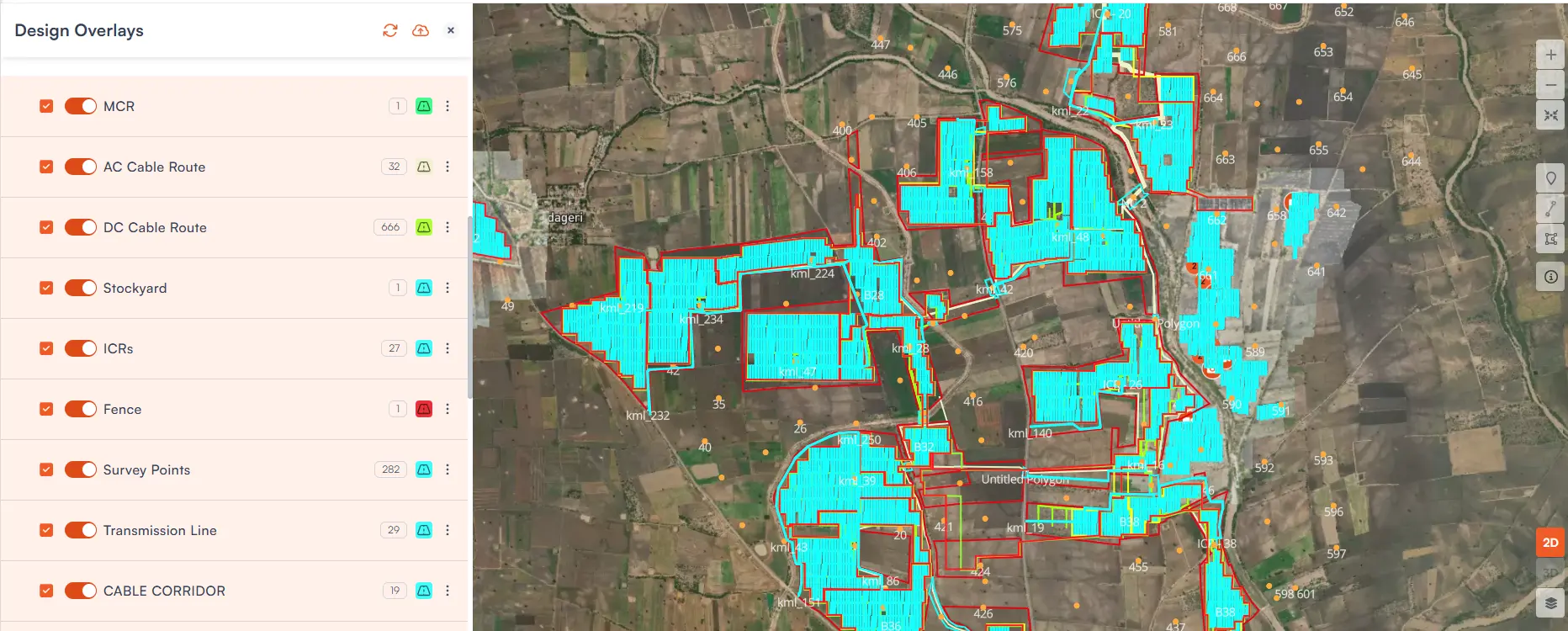
The latency between a site event and a stakeholder notification is measured in hours, not days. That compression changes the economics of large-scale EPC execution.
Strategic Impact Across the EPC Lifecycle
Construction Phase: Independent Progress Visibility
When 30+ blocks are progressing simultaneously under different subcontractors, deviations in one zone can stay invisible until they become expensive. Block-level completion metrics generated from successive orthomosaic comparisons give project managers a progress view that doesn't depend on contractor self-reporting.
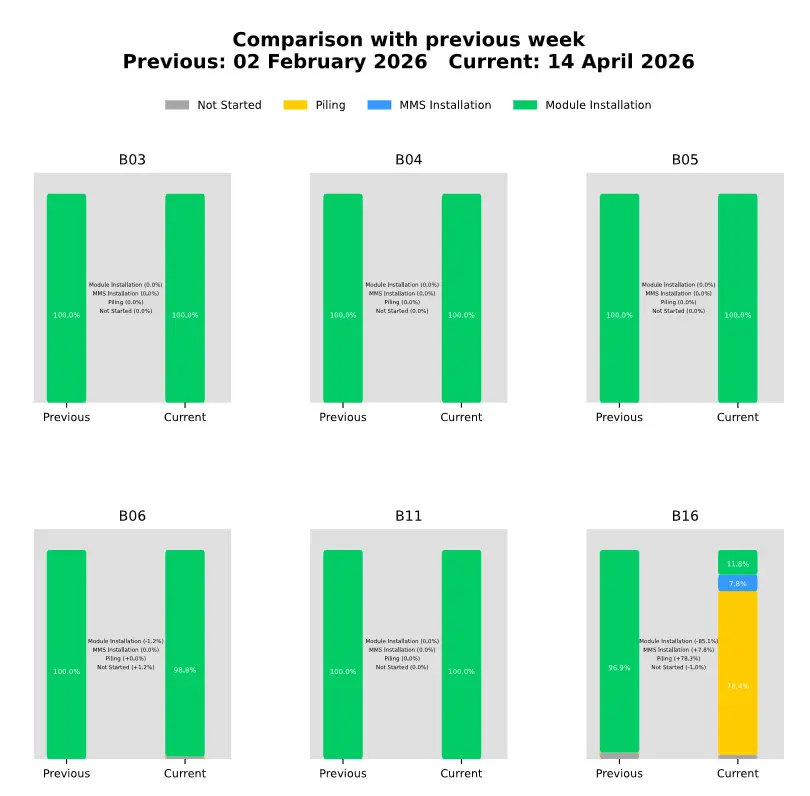
In documented deployments across large-scale EPC sites in India, this aerial oversight has enabled earlier identification of construction issues helping teams avoid approximately ~₹35 lakh in execution overruns on a single project.
Commissioning Phase: Accelerated Punch-List Closure
Commissioning is where schedule pressure peaks. Verifying installation quality across an entire EPC site manually takes weeks. Geotagged aerial imagery allows engineering teams to triage efficiently identifying which blocks require field inspection and which are clean. Thermal datasets flag electrical anomalies before they cause commissioning delays.
O&M Handover: A Live Baseline From Day One
An asset monitored throughout construction hands over with a documented record already built installation imagery, inspection history, thermal baselines, and operational flight infrastructure already commissioned. For asset owners and investors, the monitoring system is live. The data history is already built.
The Business Case: What the Numbers Actually Show
The solar farm drone inspection cost question is the wrong starting point. The right question is what continuous, independent, autonomous aerial monitoring prevents.
For EPC contractors, the case centers on overrun avoidance, schedule protection, and risk reduction. Documented deployments have shown:
- ~50% reduction in theft incidents
- Reduced security manpower, a sustained operational saving on top of avoided losses
- Measurable avoidance of execution overruns through earlier issue detection
In one such scheduled perimeter mission, a nighttime intrusion attempt was captured in real time, enabling immediate intervention and preventing material loss highlighting how continuous monitoring extends beyond progress tracking into active site risk control. (Read More)
For asset owners, the ROI compounds across the plant's operating life: lower O&M inspection costs, better fault detection rates, faster response to yield-impacting anomalies, and compliance documentation that builds in value annually.
Implementation: What Integration Actually Requires
A drone dock deployment requires power supply and network connectivity at the installation point standard on any active EPC site. Placement is determined through a pre-deployment site survey mapping coverage zones. From site survey to operational commissioning typically takes around one week.
Before specifying a system, EPC teams should verify the full pipeline: what inspection outputs look like, how observations are flagged and tracked, and what the integration path is with existing tools. The hardware is the visible part. The analytics layer and the workflow it enables is where operational value is realized.
The Shift Has Already Happened. The Question Is Whether You're Ahead of It.
The EPC teams moving fastest aren't the ones with the largest technology budgets. They're the ones that have recategorized drone dock infrastructure from "inspection tool" to "remote governance infrastructure."
The technology is mature. The deployment model is proven. The integration pathway is clear.
The teams that build autonomous aerial monitoring into their project execution plans from construction start not as an afterthought will exit every project with better data, tighter schedules, and a documented asset record that holds value through the full operating life.
Evaluating autonomous aerial monitoring for your next EPC project? Talk to our team about what a drone dock deployment looks like at your project scale.


